Resourceful York, Pa: buildings with uncertain futures stand today
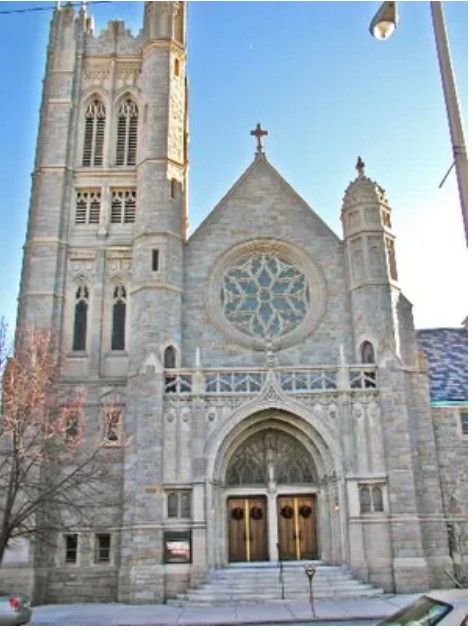
Dempwolf’s last design: Union Lutheran Church
408 W Market St., York, Pennsylvania
The situation
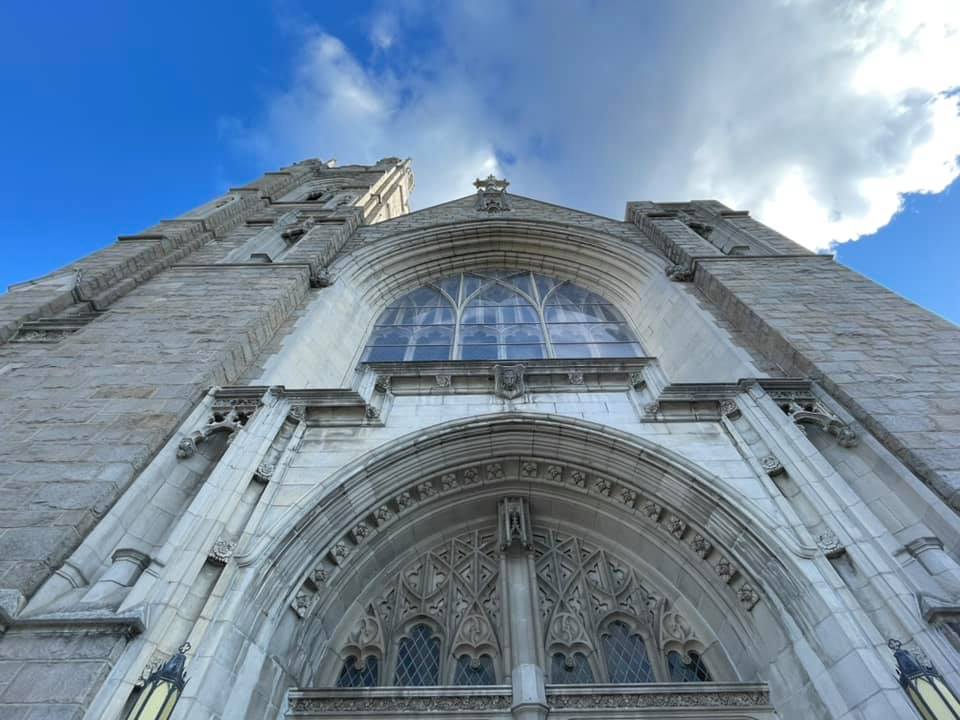
Sister buildings in two nearby Central Pennsylvania cities – York and Harrisburg. Both designed by the same architect – John A. Dempwolf.
What lessons can these two houses of worship – the former Memorial Lutheran and today’s Union Lutheran – teach?
Memorial Lutheran Church opened first. Harrisburg historian Ken Frew writes that Memorial Evangelical Lutheran Church, designed in ‘fourteenth century Gothic’ style, was dedicated in March 1928.
York’s noted architect John A. Dempwolf took on that commission and a similar job for Union Lutheran Church, and the York building was dedicated in September 1929, according to historian Rebecca Morrish Cybularz.
So, the lessons?
Dempwolf died the day before Christmas in 1926, so he didn’t see the final design or construction of either building. Union Lutheran stands today as the last ecclesiological building designed of about 90 houses of worship in the 50-year John Dempwolf era. His son, Frederick – known for his designs of Martin Library and York’s former city hall, now the city police station – carried on after his death. With an additional design by noted architect B.F. Willis and stained-glass windows by J. Horace Rudy, Union Lutheran is a building of architectural and historical consequence.
The Harrisburg building gained life after the Lutherans, its congregation giving way to Coptic Christians – St. Mark’s Coptic Orthodox Church. (The Copts are an ancient Christian group, particularly found in Egypt. A Coptic congregation meets in a former United Methodist Church in Dallastown.)
This story about reuse of its sister building by another religious group could provide an example for Union Lutheran’s congregation to consider as it ponders the future of its landmark York building. The congregation is without funds for upkeep of the large building with a five-level bell tower, but desires to continue its ministry to its neighborhood.
This West Market Street’s congregation has proposed razing its building to make way for affordable housing. The congregation would retain space in a community room in the proposed new complex. This proposal has drawn considerable community controversy, and it is now in the city review process. A recently formed Facebook group provides an opposition voice – (7) SAVE YORK’S UNION LUTHERAN CHURCH | Facebook.
In summary, it’s hard to bring up an example of the demolition of a historical or architecturally significant building in the city in the past 35 years other than perhaps the Lincoln Highway Garage.
The witness
Since about 1975 when the East Market Street’s Billmeyer House was saved from demolition, York and York County leaders have searched more thoroughly for alternatives to razing when buildings become endangered. Here is a sampling of significant structures that have been saved or adapted for reuse since about 2000, some or all might provide ideas for Union Lutheran other than demolition:
– New congregations move in: A Latino congregation – The Potter’s House Pentecostal Church – moved into the threatened former Trinity United Methodist Church building on East King Street, and First Spanish Assembly of God worships in the former Memorial Church, a South Queen Street building originally associated with York’s Trinity United Church of Christ. Another congregation, Zeal Church, started worshipping in the former Otterbein United Methodist Church at West Philadelphia and Newberry streets. The congregation meets today in the restored bank, the YMCA’s TechRev Center, 301 W. Market St. The former Otterbein Church bears a sign for Pennsylvania Counseling Services. Noble City Church meets in an old church building at 450 W. King St. The former Zion Lutheran building is being adapted as convention space for the next-door Yorktowne Hotel. York Art Association is moving into the vacant Little Green Church in the Avenues.
–Front support: In 1996, the distinctive facades that defined the streetscape in the first block of South George Street, across from city hall, were preserved with new construction supporting them from the rear.
–Expanding next door: Some community icons have expanded into significant adjoining buildings. Martin Library’s moved into the next-door brownstone building as part of a renovation. For many years, the Appell Center has operated next-door in the former Lehmayer’s clothing store on North George Street.
–Adapting and reusing: Housing is in such demand that many massive structures have been adapted rather than razed. Three among many examples have been turned into housing: The former J.E. Baker building on West Market Street; the former Keystone Weaving Mills in West York and the former Red Lion Table Company. A fourth major example comes with the adaptation of the former Met Ed steam plant into the York County History Center’s new museum.
–New market places: At least two former manufacturing buildings have been turned into markets: Ebert Furniture became Franklin Street Social in Red Lion and the former Fishel Bakery in West York operates as the Bakery Complex. The former New York Wire complex on East Market Street is now the multi-use New York Wire Works, a complex that includes an eatery, bar and office spaces.
–Home for the homeless: Lifepath Christian Ministries is reworking the former Pewterex and York Manufacturing Co.’s ice-machine complex at 145 N. Hartley St. to aid and house the community’s homeless population.
–The big three: Three iconic venues, which first emerged in the 1920s, have undergone major renovations: Valencia ballroom (1990), Yorktowne Hotel (2023) and Appell Center for the Performing Arts (1980, 2003, 2018).
–Recycling at Logos: Logos Academy on West King Street adapted a former metal recycling site into a Lower School building and a former automobile dealership across King Street into an upper school.
–Housing in Hanover: The landmark McAllister Hotel has been renovated into market rate housing, with a restaurant and coffee shop. The future of the Fisher-Crouse house, Hanover’s oldest home, was in doubt after the borough of Hanover sought a new owner. The house later was acquired by a private owner.
–Along Penn Street: Key buildings along the milelong stretch of York’s Penn Street and its corridor has seen – or will see renovation: the former Schmidt and Ault paper mill became York College’s Knowledge Park, the former Dentsply complex is designed to be transformed into multi-use space, Penn Street Market received $1.5 million in state money for restoration and the large building at 20 N. Penn St., has been renovated into housing.
Eastern adaption: The Zimmerman Center moved into the restored Dritt House at Lower Windsor Township’s Long Level and Hellam Township’s Mifflin House and farm is being restored into a welcome center, Underground Railroad and Civil War site. The Susquehanna National Heritage Area operates both sites.
So there’s a recent track record in the city and beyond to creatively keep significant structures standing. York’s Architectural Review Board will hear about the project on Dec. 11.
To be sure, the restoration track record is not 100% when you include buildings in the county. The Ramsey Theater in Stewartstown, the oldest movie theater in a small town to be built to show films, has been demolished. The remaining Avalong dairy barn on Whiteford Road was razed to make way for a bank. The old Springettsbury firehall came down for a shopping center. Also in Springettsbury, the Modernaire Hotel and the landmark Bloomingdale house appear to be threatened by a shopping center. The Glen Theatre in Glen Rock and the Hanover Theatre are awaiting investment and reuse. The future of the Hoke House in Spring Grove is promising as it awaits funding for relocation.
Background links/building preservation
- The Frey Avenue neighborhood in the South Broad Street area, long remembered by many, was razed to make way for high-rise apartments. Similarly, the Codorus Street neighborhood was demolished, and today Martin Luther King Jr. Park covers that site.
- Photos: These York County buildings were jacked up and moved.
- Historic, community sites gain $1 million+ awards – Witnessing York. (This covers many new and adaptive reuse projects).
- Significant York landmarks: Victim to wrecking ball in 1950s-1970s
- Watch: 5 York buildings that should never have come down.
- Photos: These York County buildings should have never come down.
- These York County landmarks escaped demolition.
- Stop the dozer: These York County buildings should be saved.
The questions
How does a community weigh the demolition of a landmark v. the building of needed affordable housing in its place? Do we often enough take a step back and seek a third way to address community needs whether in preserving iconic structures or in solving other community issues? Or is third-way thinking now in our community DNA?
Related links and sources: Union Lutheran Church’s proposed demo sparks preservation effort;Union Apartments affordable house proposal outlined at York Rotary. Photo in viewer, York Architecture; Rebecca Morrish Cybularz‘s A Survey of the Ecclesiastical Building of the J.A. Dempwolf Architecture Firm, York, Pennsylvania. St. Mark’s photo, Joe McClure; Union Lutheran photo, YDR; Community Progress Council photo, Jim McClure.
— By JAMIE NOERPEL and JIM McCLURE