The 1700s: A decade-by-day look at York County’s past
York County in the 1700s
Continental Square, York
The Situation
(This is the first of a four-part special Witnessing York series providing snapshots of each decade since the founding of the village of York in 1741. Some of these stories were published in the York Daily Record in connection with the 275th anniversary of York city in 2016).
Contra to conventional wisdom, York County has never been a sleepy place. In fact, it was often wide awake, though never to be confused with Philadelphia. It was a crossroads particularly after 1730, with dirt roads converging from many compass posts in York’s square. That was Centre Square, Continental Square today.
And it was just not any crossroads. It served as the first major intersection after settlers took John Wright’s Ferry after 1730 and disembarked west of the Susquehanna. The main east/west road moving through there became known as the Great Wagon Road, the path for settlers to move from Philadelphia and other eastern ports to the Shenandoah Valley and points south.
When a village is a major crossroads, things happen. Strangers meet and become friends. And sometimes enemies. Past friends unite as do enemies. So you sometimes have conflict.
And the Great Wagon Road served another purpose in the 1700s. A path for Continental Army troops to move to battle. And statesmen to journey to Continental Congress in the American Revolution. This network of roads, bridges and later railroads contributed to York County’s key position in three wars – the Revolutionary War, Civil War and World War II.
And thus, we start this series of moments covering 30 decades of European setttlement in York County, starting with the village of York’s founding in 1741.
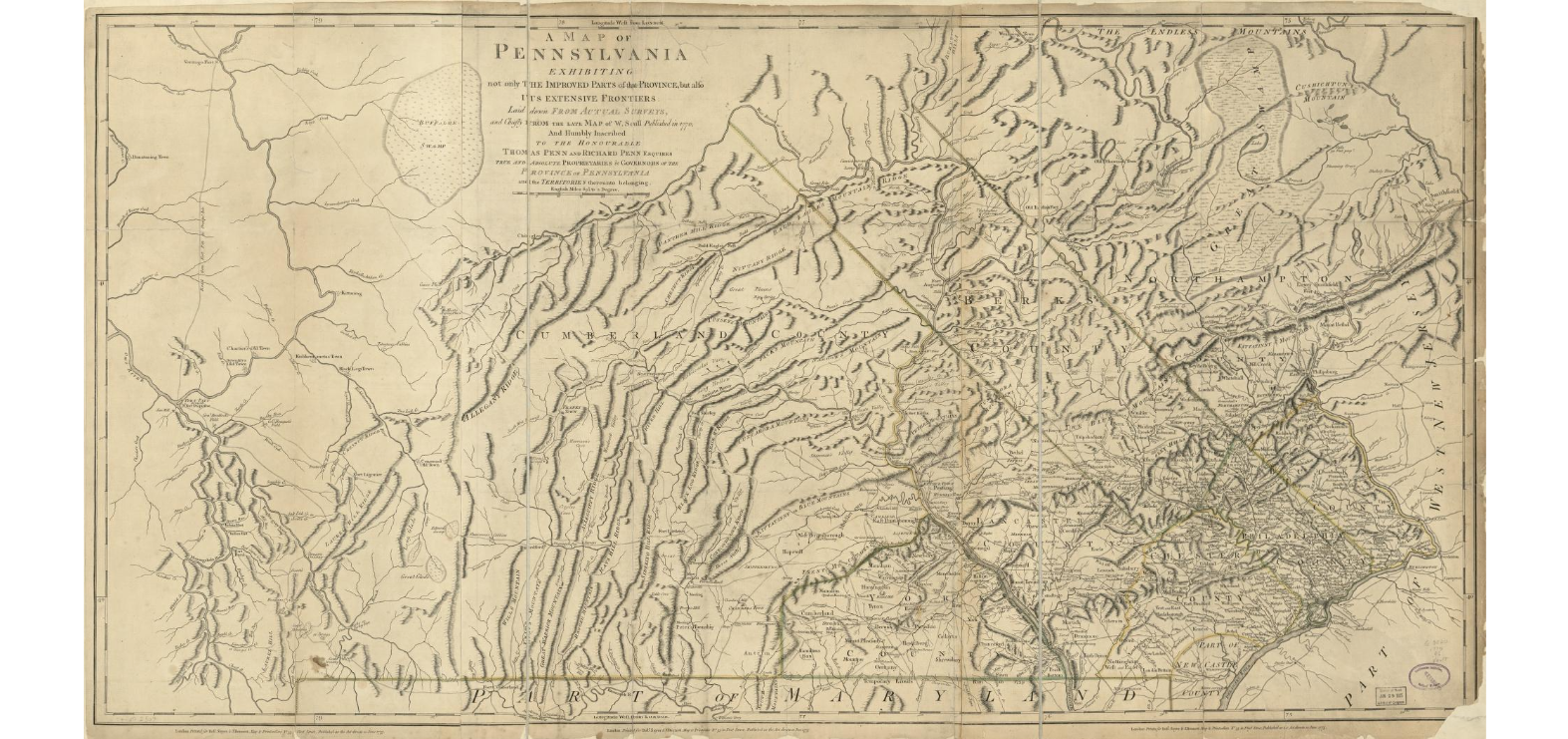
For a timeline of Native Americans in future York County before its founding in 1749, please see: Native Lands County Park – Peaceful path saw war – Witnessing York
The Witness
1740s: York County wears age well
York County just passed its 275th anniversary. Now many counties in Pennsylvania go back that far? Only four, and York County was the first west of the Susquehanna.
All these dates and numbers can be confusing, but we’ll add two more: The village of York goes back eight years before York County’s founding in 1749.
York – a borough in 1787 and a city in 1887 – is old by Pennsylvania standards, but this seasoned and gritty gray guy is gaining new strength in 2020s with the infusion from the creativity of artists, energy from smart builders and its location in a recreation-rich county.
Back to York’s beginning in 1741:
Thomas Cookson, an agent of the Penns, surveyed the site for the town of York. The town, named after Yorkshire, England, the White Rose City, tied its founding to this survey. The part of the town east of the Codorus Creek was laid out in squares, in the manner of Philadelphia.
Cookson followed these directions: “The squares to be 480 feet wide; 520 feet long; lots 230 by 65; alleys 20 (feet wide); two streets 80 feet wide, to cross each other, and 65 feet square to be cut off the corner of each lot to make a square for any public building or market of 110 feet each side; the lots to be let at 7 shillings sterling … the squares to be laid out the length of two squares to the eastward of Codorus when any number of 20 houses are built.” The town reportedly included 256 building lots.
The names of some of the earliest York residents are evident in York County today, although some have been Americanized: Croll, Laub, Eichelberger, Welsch, Spengler, Swoope, Shugart, Bott, Hoake, Crebill and Hendricks.
The scenic Susquehanna’s west bank
At first, there wasn’t much there. There was a road – the old Monocacy Road – that was little more than a dirt trail wide enough for wagons to pass. You wouldn’t feel threatened by American Indians. The most prominent group, the Susquehannocks, later Conestogas, were largely gone by then, and they were a peaceful group in the first place.
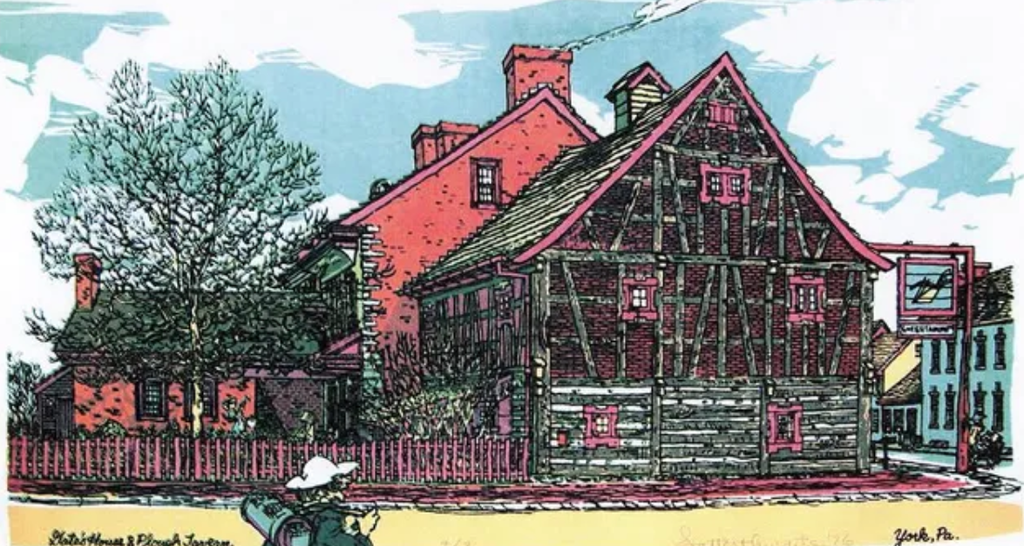
But you would have been struck by the remoteness of the spot. This really was the edge of Pennsylvania’s backyard. But if you stuck around long enough, you’d see surveying teams with their wooden tripods, transit levels and sturdy compasses at work. And then you’d hear pounding as workers put up Martin Eichelberger’s place, just up the rise from the Codorus Creek in the village of York. Eichelberger might have initially built the first story of his place and then followed with a half-timbered second level – a construction technique seen in these largely German parts of Pennsylvania. One by one, buildings went up on those lots lined out by the surveyors.
In eight years, enough settlers lived in and around York that they petitioned Lancaster County to separate. Residents needed their own sheriff to guard against the threat of a growing criminal element. York now was in the middle of somewhere, with settlers moving along the Great Wagon Road – Market Street today – to points south and west.
And the place that Martin Eichelberger built? It’s now known as the Golden Plough Tavern.
+++
1750s: ‘Mrs. E., the life of all the gaiety’
About 1758, Elijah Etting, thought to be the first Jewish settler in the county, set up a small store.
Etting kept in contact with the Lancaster Jewish community and gained influence in his own county. Joseph Simon of Lancaster, for example, asked Etting to intervene with the Continental Congress, meeting in York in 1777-78, on his behalf concerning a financial matter.
Alexander Graydon, later a well-known lawyer, spent part of a summer in the Etting household in 1773.
As described in his memoirs, Graydon found hospitable reception unavailable in York, except at the Ettings.
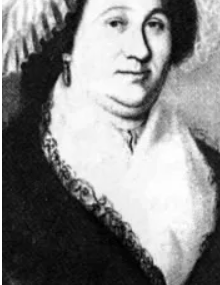
He particularly relished the hospitality of Shinah, Elijah’s wife: “Those who have known York … cannot fail to recollect the sprightly and engaging Mrs. E., the life of all the gaiety that could be mustered in the village: always in spirits, full of frolic and glee, and possessing the talent of singing agreeably . …”
No tidy town
Don’t think of York in its second decade as a tidy Pennsylvania Dutch town.
Think of TV westerns in which a gunslinger rides his horse into a town with dirt streets and uneven wooden houses, only that York Town, as it was then called, had some brick and stone structures.
Let’s stand in Centre Square, now Continental Square, for a minute and look west down what became known as Market Street.
You’re next to the sturdy brick Centre Square courthouse, up by 1756 in the center of the square. A stone house, the Gates House today, later went up westward on this main street. It stood right next to Martin Eichelberger’s Tavern, now called the Golden Plough.
York’s streetscape was gap toothed. Well, it had more gaps than teeth.
Not all the lots were built on. Back and side yards served as places for livestock to graze.
Running water wouldn’t come until 1816, after the Codorus Creek, a couple of blocks westward from the square, became too polluted from sewage and commercial waste.
There were outhouses, but household and human waste of all sorts found their way into the streets and then into the Codorus.
York was a frontier town, a German village standing on the edge of America.
It was found largely wanting of amenities and fellowship by law student Alexander Graydon – and the Continental Congress visiting here in 1777-78.
Yet Graydon found time for fowling, riding or strolling along the Codorus, “a beautiful stream that passes through town.”
+++
1760s: A time for building
Buildings are going up around the village York in the 1760s.
The Willis and Cookes houses, in two different parts of town, are among those sturdy structures.
So sturdy, in fact, that they stand today.
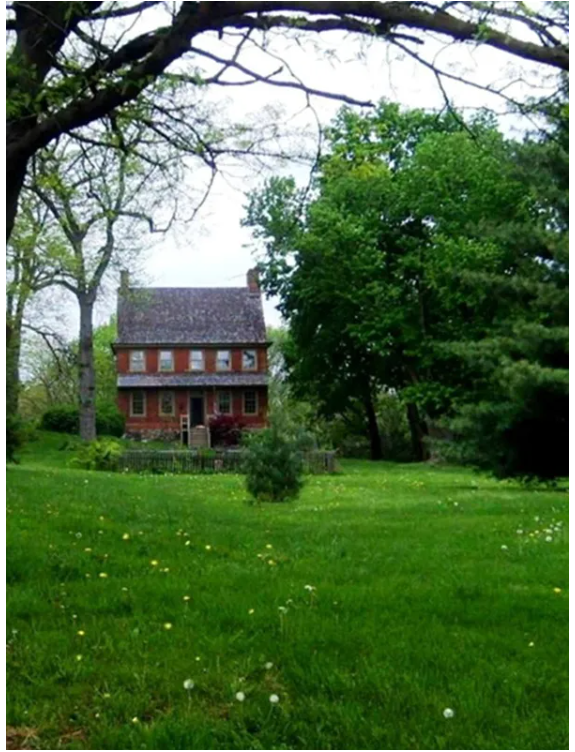
Here’s a look at the Willis House, courtesy of Never to be Forgotten, 1762:
“William Willis, the prominent Quaker builder of the county courthouse, constructs a classic Georgia home with double English-style chimneys in an unsettled part of York.
“Today, the house remains in use as a private residence, nestled in a rural setting not far from the center of York.
“A 19th-century girl’s reflections from a seat at the York County Academy fit the scene today: ‘There to the left is Willis’s woods, how delightfully cool it looks this afternoon with the cloud shadows passing over it. I know of deep shady hollows … rich with the breath of pine trees, where the school girls have spent long lovely days.’
Imaging the Willis House in the 1760s
That schoolgirl saw the woods around the Willis House as remote and inviting. That was decades after the house was built. When William Willis built it, it was on the edge of the village. It was a pioneer’s house.
No doubt the nearby stream later named after Willis attracted him to the spot. The house’s position next to a hill – later known as Prospect Hill topped by a cemetery – sheltered it a bit from the elements.
Willis was a Quaker, a denomination known for anti-slavery views. So that remote area – still on the edge of things before the Civil War – became a refuge for slaves on the run.
The National Park Service’s Network to Freedom says this about the Willis property:
“William’s son, Samuel Willis, became one of the leaders in the Underground Railroad. He resided in his parent’s homestead and hid slaves in the barn or in the rows of the cornfields. The pursuit at one time became so threatening that the fugitives were hidden in corn shocks until it was safe to move to more secure concealment.”
Today, that remote spot in northwest York chosen by William Willis remains remote, off a lightly used road and wedged in its green area between the York’s urban sprawl and Prospect Hill Cemetery.
+++
1770s: The decade that defined York County
Ah, the 1770s, the decade that brought Continental Congress to York, then known as York Town, for nine months in 1777-78.
That was the Valley Forge winter, when George Washington’s Army hunkered down between the British in Philadelphia and America’s Founders in York Town, 90 miles away.
The following comes from Jim McClure’s “Never to be Forgotten, ” summarizing that winter of 1777-78, when the nation’s future swung in balance and its leaders labored in York Town, on Pennsylvania’s frontier:
John Hancock, Samuel Adams, Roger Sherman, John Witherspoon, Robert Morris, Richard Henry Lee and Francis Lightfoot Lee work in York to adopt the Articles of Confederation, America’s first constitution and forerunner to the U.S. Constitution.
The Articles of Confederation, finally ratified by the states in 1781, begin: “TO ALL TO WHOM these Presents shall come, we the undersigned Delegates of the States affixed to our Names send greeting. ”
Article I stated, “The Stile of this confederacy shall be ‘The United States of America.'” The Articles gave Congress the right to raise an army and navy, wage war, fix standards of coinage and provide a postal service.
The use of “United States of America” in a legal document, giving the central government authority over the states, gives impetus to the claim that York County was the first capital of the United States. Today, most historians dispute this status, noting that the country’s name appeared on Continental currency and on the Declaration of Independence signed in Philadelphia in 1776 and on Continental currency. Continental Congress also resolved in September 1776 that that the name of the new nation would be the United States of America.
Further, they argue the Articles dThe American government has met in York and eight other places: Philadelphia (four times); Baltimore; Lancaster; Princeton, N.J.; Annapolis, Md.; Trenton, N.J.; New York City and Washington, D.C. A convention met in Philadelphia in 1787 to draft the U.S. Constitution, successor to the Articles of Confederation.
Imagine this
What was life like for the 50-something delegates, who served in the Continental Congress in its stay in York Town?
This excerpt from a York Daily Record/Sunday News editorial on Dec. 24, 2008, gives a glimpse of what South Carolina’s gout-ridden Henry Laurens went through:
The widower was in a rented room. In bed, aching from gout. His home was in South Carolina. But not all of his family was down South. His son, John, was an aide to George Washington, the great general himself cut off from loved ones for much of that Revolutionary War winter in Valley Forge. That war would later claim John’s life – and that broke his father’s spirit. Here Henry Laurens was in York, with the Continental Congress in the dark, early stages of a revolution that was looking bleak and offered no exit strategy.
But he wasn’t just with Congress. He was president of Congress. And not many delegates had hung around that Christmas for him to lead. At times that winter, maybe 20 delegates served as America’s governing body in that great war with Britain. Laurens’ gout confined him to bed, or to crutches, or to crutches, or to be carried back and forth between his quarters and the courthouse. Every day, he faced countless hours of work.
“Perhaps two, it may be three, hours after dark I may be permitted to hobble on my Crutches over Ice & frozen snow or to be carried to such a homely home as I have,” he wrote to a friend, “where I must set in Bed for one or two or three hours longer at the writing Table, pass the remainder of a tedious night in pain & some anxiety.”
He was tempted to turn in his delegate’s badge, but reconsidered.
“I will not quit my post,” he wrote, “although I have some grounds to fear that I may perish on it.” Even when his time as delegate was up a couple of years later, he shipped out to Europe as a diplomat to Holland. The British captured his ship and threw their prize prisoner in the Tower of London. There, he stayed. Alone. That broke his health.
+++
The 1780s: The enemy roams York’s streets
After Cornwallis’ surrender at Yorktown, Va., in 1781, the American Revolution largely moved from the eastern seaboard.
It would take two years of widespread fighting in scattered places around the world and then hard work on the treaties in Paris setting post-war terms.
But in York Town, Pa., the surrender in Yorktown, Va., again brought the war close to home.
Those prisoners from Cornwallis’ surrender?
Many appeared in York Town – in a hastily built prisoner-of-war camp east of the town.
Here is is excerpt from “Never to Be Forgotten” summarizing that POW camp that operated from 1781-1783 and whose site is being explored by archaeological diggers today:
County militia guard Camp Security, a prisoner-of-war stockade for British troops from the commands of Burgoyne, Cornwallis and others. Col. James Wood builds the stockade on Daniel Brubaker’s land, about a mile south of Route 462 in future Springettsbury Township. Actually, the prisoners build the huts, and soldiers likely handle the important task of constructing the stockade. The soldiers drive 15-foot-long wooden posts, sharpened at each end, into the ground. Prisoners suffer the normal maladies of prisoners of war — disease and food and clothing shortages. And numerous escapes by British prisoners suggest something else about the prison: Camp Security is not secure.
In addition to Camp Security, Redcoats also were detained in the York County Prison at King and George.
Imagine this
From Jim McClure’s “Nine Months in York Town”:
Walking the muddy streets of York in 1782, and you would see British officers out on parole.
And they would not keep to themselves. Townspeople complained of their interactions with young people in town.
“We had a very disturbed night owing to the set of rascals who swarmed around our house, intent on doing evil deeds,” Moravian pastor George Neisser wrote in his diary on Aug. 1, 1782. “These wicked persons are very offensive.”
More than six months later, the problem persisted.
“During a visit in Bottstown (west of the Codorus Creek), I heard much from Bro. John Rothrock and others about the wicked and lewd conduct of the British officers during their stay here, who had exercised a very demoralizing influence on our young people,” he wrote.
York’s people has suffered much in fighting the British and hosting demanding delegates to Continental Congress in 1777-78. Now enemy soldiers were walking York’s streets.
Also in the 1880s:
The village of York became old news in 1787 when the borough of York was formed. The borough was York County’s first. Over the years, York County celebrations have been connected to this moment of incorporation, as well as to the founding of the village of York in 1741.
Here’s the summary from “Never to be Forgotten.”
York incorporates as the county’s first borough, becoming part of a patchwork of small-scale municipal governments that bring elected officials close to the people — an advantage touted to this day. Some present-day geographers believe the county’s 72 independent municipal and township governments and 16 school systems foster uncontrolled sprawl, fiscal disparities and greater racial and economic segregation. Henry Miller, Revolutionary War veteran and holder of several public offices, serves as York’s first chief burgess or mayor.
+++
The 1790s: Gay Nineties in York, Pa.: The 1790s, that is
You could have called the 1790s in York, Pa., the “Gay Nineties.”
A lot was going on around the new borough that decade – a full century before the decade known by that famous moniker.
York Town’s considerable involvement in the American Revolution had caused its economy to transition from that of a German peasant farming village to a borough with a growing market-oriented economy, according to York College of Pennsylvania history professor Paul Doutrich.
Institutions in York Town – some with us today – started to emerge after the war and through the end of the century.
York Academy, founded in 1787 by St. John the Baptist Episcopal Church, was one of them.
Here’s an explanation from “Never to be Forgotten’s” of growth in this school, which later represented one of two predecessors to York College of Pennsylvania:
The York County Academy accepts girls as students and offers co-ed classes. “Opened in the Academy — An English Classical School, on a plan entirely new, but which has been approved by some of the first literary characters in America,” a newspaper advertisement said. “The principal object of the plan … is to make the youth of both sexes intimately acquainted with the English language, to teach them to read, not only with correctness and elegance; but to explain the meaning, to point out the beauties of the best authors in the language; and in this manner to cultivate the understanding, and improve the taste at an early period of their lives.” The joint classes continued until 1823 when the boys school starts meeting on the first floor and the girls school on the second.
Imagining York
If you walked down High Street – Market Street as we know it today – in the 1790s, you would conclude that the town was losing its baby teeth and that its permanent molars were starting to appear.
The Laurel and Vigilant fire companies were on the scene, important because of the prevalence of fires in poorly constructed chimneys. A borough police department was being formed, pointing to a growing criminal element.
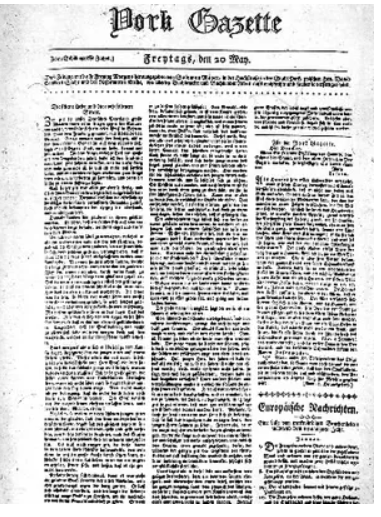
A German-language weekly newspaper could be found around town. It was run by Solomon Meyer, a reputed rascal and colorful anti-Federalist who regularly picked fights with those favoring strong government.
York County Academy, with a brand new building, was operating on a lane, Beaver Street, connecting with York’s main street.
The biggest change came in the heart of the borough, in its Centre Square. Since 1756, the county courthouse and market sheds stood there. Now, a building called “The State House” joined the courthouse. Even in the 1790s, government was growing, adding English speakers to the town’s dominant German culture.
Both enslaved people and freed Blacks walked the dirt streets, as well. The county was first among counties in Pennsylvania in number of slaves and second in freedmen. The latter was a growing group with the Gradual Abolition Act of 1780 manumitting bondsmen.
From the perspective of the 1790s, the painful American Revolution had been good for York.
“The war clearly accelerated Yorktown’s evolution and thrust the town into modernity,” York College’s Paul Doutrich wrote in his 1985 dissertation. “The war ended a period of semi-isolation in which York achieved the socio-economic stability that it would need to participate actively in American affairs during the 1770’s and 1780’s.”
Jamie Noerpel and Dominish Marie Miller talk about the predominant Native American group, the Susquehannocks, in this episode of Hometown History.
The question
In your opinion, is York County “awake” today? In what ways are we in touch with national celebrations and issues, and in what ways do we appear tone-deaf?
Related links and sources: Jim McClure’s Never to be Forgotten, (1999 & 2024 editions) and Nine Months in York Town. Photos, Library of Congress viewer; “Colonial Mother, York County History Center, all other photos, York Daily Record.
— By JAMIE NOERPEL and JIM McCLURE